
The Values on a Pike County Property Record
Name the number first. Assessed value, market value, and sale price are different measures. Indiana assesses at a 100 percent market-value-in-use level, and a Pike County deed speaks to only one transaction.
| Value | What It Is | Where |
|---|---|---|
| Assessed value | Mass-appraisal figure used for taxation | Pike County Assessor |
| Market context | Market-value-in-use assessment context | Pike County Assessor and DLGF |
| Last sale price | Consideration for a specific transfer | Deed or sales disclosure route |
| Land vs improvement | Separate assessment components when shown | Pike County Assessor |
Ratio analysis divides assessed value by sale price for qualified study sales. It calibrates assessments across many properties, and it cannot turn one parcel's assessment into a guaranteed selling price.
Compare Pike County Property Value Types
Keep the source and date beside every figure.
| Value type | Meaning | Where recorded |
|---|---|---|
| Assessed value | Mass-appraisal figure used in property taxation | Assessor and parcel record |
| Market context | Market-value-in-use and ratio-study evidence | DLGF guidance and county studies |
| Last sale price | Consideration from a particular transfer | Deed or Sales Disclosure Form route |
A private appraisal uses a different purpose, effective date, and analysis.
Indiana's 100 Percent Pike County Assessment Level
Indiana's Department of Local Government Finance oversees the market-based assessment system and its 100 percent level. Its ratio formula compares assessed value with sale price. The goal is fairness across parcels. The formula never promises an offer.
Value terms
Assessed value is the official mass-appraisal figure. Market value is a dated opinion of worth in a given market. Sale consideration reports the amount conveyed, reassessment rebuilds the base, and annual trending tracks market change.
Pike County's 2025 Ratio Study
Pike County's 2025 ratio study draws on sales from 2020 through 2024 and breaks its results out by township groupings. Across all townships combined, the study reports a mean ratio of 102.26, a median of 103.75, and a coefficient of dispersion of 5.83. Read those numbers as a picture of the sample and of how assessments performed countywide. They do not pin down the value of one particular home or tract.
Parcel-level study fields matter only when the subject property sits inside the qualified sample. If it does not, use the study as county context and let the parcel record supply the assessed figure.
January 1 Sets Pike County's Assessment Date
January 1 sets Pike County's assessment date. A later sale answers a different time question. The Assessor tracks physical characteristics, land area, location, market conditions, and sales. Indiana also requires annual adjustments. Record the year, the sale date, and the retrieval date separately. The indexed property interface offers historical year choices from 1989 through 2026. A year option alone does not prove completeness. Every value field may not be filled for that period.
The indexed Pike property portal shows parcel search modes.
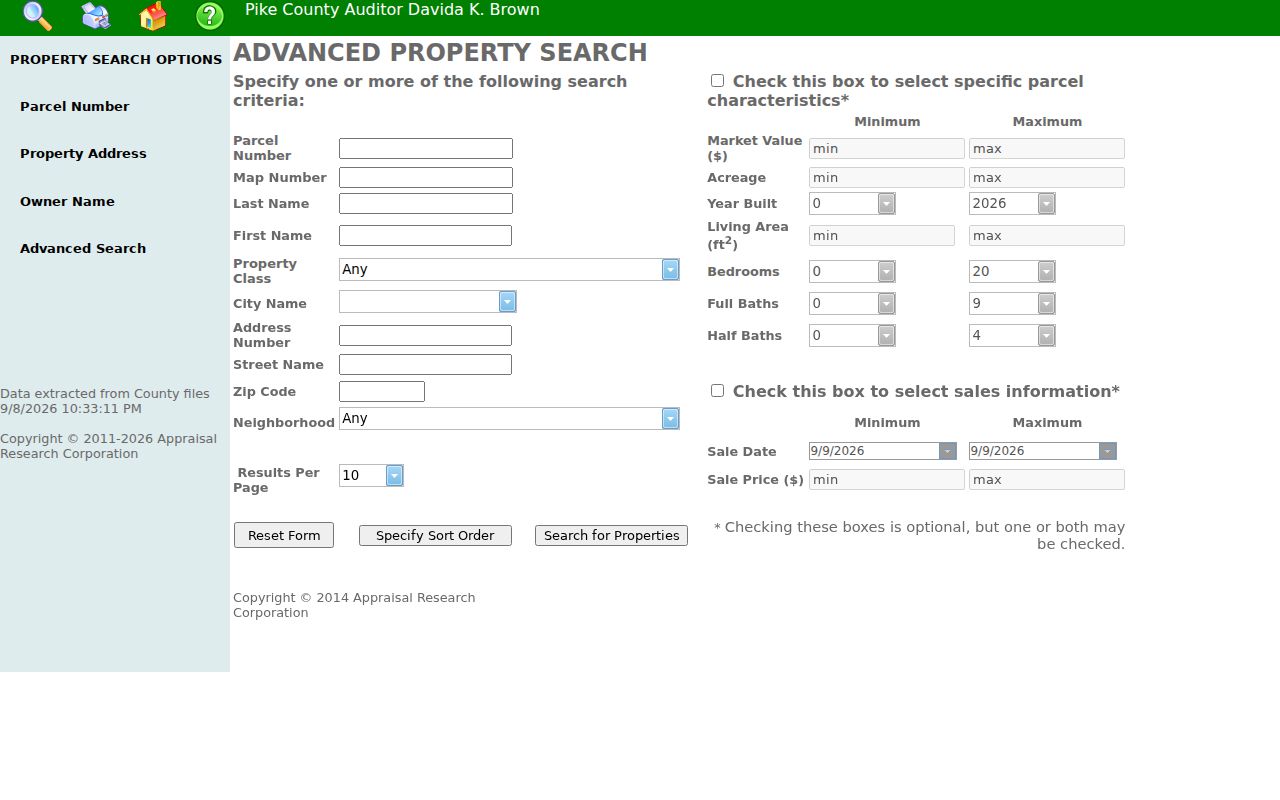
The capture supports the route; live value labels still require verification.
Land and Improvements in Pike County Values
A Pike County parcel value may break into land, improvements, and a total. Those are standard assessment components. The county does not publish its parcel-card field labels, so confirm them on the live record. DLGF ratio-study data offers another official context. Never use it to invent missing fields. When an online result stays unclear, ask the Assessor at 812-354-6584 for the property record and the value components available for the relevant assessment year.
Recorded Pike County Sale Prices
A deed's consideration documents one sale. Indiana's Sales Disclosure Form route records transaction value as well. State guidance assigns Form 46021 to conveyances for valuable consideration. It generally takes one form per parcel, subject to the contiguous-parcel rule. The instructions identify a $10 county Auditor fee. No official Pike County sale-price display is confirmed. Compare the deed, the disclosure, and the sales tab. Do not assume a portal amount carries the same meaning and completeness as the recorded transaction.
Coal and Solar Shape Pike County Context
Pike County's value patterns have a local shape. The DLGF county narrative ties assessment change to coal generation and mine closures. It also cites a large tax-base decline, township grouping, Lake Helmerich recreation, and newer solar development. That context explains broad movements. It is not a forecast for one parcel. Compare like property classes, township or neighborhood schedules, land use, and dates before drawing any conclusion about a Pike County assessed value.
Deductions Change Pike County Taxable Value
Gross assessed value is not net taxable value. Deductions, exemptions, credits, and caps reshape the tax calculation after assessment. County and state material covers Form 136 routes. It also flags pay-2026 changes for solar and geothermal treatment plus over-65, blind, and disabled provisions. This page stops at the distinction between value figures. For bill calculations, filing rules, and assessment challenges, turn to the property tax records guide.
Looking Up a Pike County Property Value
Search the Pike County property portal by address. Save the exact parcel number. Open the matching record. Select the relevant year when offered, and record the land, improvement, and total figures only if the live result labels them. Compare any sale entry by date and source, and if the parcel was split or combined, search the owner name and contact the office.
- Search the address in the Pike County property portal.
- Record only labeled values and their year.
- Compare a sale figure with the deed and disclosure.
- Use official study context without predicting a sale.
- Assessed value
- The official mass-appraisal figure.
- Market value
- A date-specific opinion, not a sale guarantee.
- Assessment level
- Indiana's 100 percent market-value-in-use framework.
What a Pike County Assessor Value Is Not
A Pike County assessed value serves public administration through mass appraisal. It is not a title opinion or sale guarantee. Markets can shift after the assessment date. A single sale may carry terms the public figure never explains.
Key distinction. Assessed value supports taxation. It is not a promise of what the property would sell for and is not an appraisal.
Value vs price. [1-2 sentences - a Pike County assessor value is not what a property will sell for; for a sale or loan, get a licensed appraisal.]
Checking a Pike County Assessed Value Offline
The portal may leave out a year or a value component. Call the Pike County Assessor at 812-354-6584. Have the APN, situs, owner string, assessment year, and the exact record you want ready. The office holds physical details like building size and type, land area, and location. It also holds assessment and sales context. Ask for the existing record. Staff will not produce a fresh appraisal on request.
Indiana APRA backs a narrow request for a non-exempt assessment record. Inspection is generally free. Copies and certification may cost something. A response deadline does not guarantee that a complex archived production finishes that day. Sort out format, delivery, and cost before ordering.
Pike County Property Value Notes That Travel Well
A good worksheet earns its keep. List the parcel number, situs, legal description, class, land and improvement figures where shown, total assessed value, assessment year, last sale date and source, and retrieval date. Keep deductions and net taxable value on separate lines. That way a tax adjustment never masquerades as a change in gross assessment. Sloppy worksheets produce exactly that confusion. State plainly what the numbers cannot do. A county ratio cannot establish present market price on its own. Neither can a neighborhood schedule, tax row, or dated sale. When a value decision carries real stakes, get valuation work built for that purpose.
Values do not sit still. Recheck any Pike County property value when the assessment year turns over or a new transfer hits the deed records. A dated worksheet keeps a historic figure from blending into an active assessment. That same discipline stops sale amount, gross assessed value, deductions, and net taxable value from collapsing into one misleading number. It also hands the Assessor a clean reference point if a field ever needs explaining.