
Pike County Tax Record Fields
Three offices split Pike County property tax records. The Assessor keeps property characteristics and sets assessed values. The Auditor applies deductions and credits and runs assessment administration, while the Treasurer issues bills, collects payment, tracks balances, and manages delinquency and tax-sale status.
| Field | What It Shows | Where |
|---|---|---|
| Physical record | Building size and type, land area, and location | Pike County Assessor |
| Assessed value | Annual value used in Indiana's tax system | Pike County Assessor |
| Deductions and credits | Adjustments applied before the final liability | Pike County Auditor |
| Bill and payment status | Tax year, amount due, receipts, and delinquency | Pike County Treasurer |
| Tax-sale entry | Property ID, sale ID, owner, description, amount, and status | County notice and Treasurer |
Indiana assesses property at 100 percent of market value-in-use. That standard is not a promise of sale price. Deductions and credits can pull net assessed value below gross assessed value, while tax rates and caps shape the final bill. Always read the year beside every figure.
January 1 Pike County Values
January 1 is the assessment date in Pike County. The Pike County Assessor sets that standard and tracks property characteristics, sales, and market conditions for annual adjustments. That date anchors the value record, while taxes are usually discussed by a later pay year, and mixing the two labels can make a valid record look inconsistent. Taxes use a later pay year.
Parcel cards often show land, improvements, and total assessed value. The county publishes no live card. Use the value fields the current result actually shows. If a parcel changed after January 1, compare the assessment date, the deed recording date, and the bill year before drawing any conclusion. Only then settle on an answer.
- Assessed value
- The value placed on the parcel for property-tax administration.
- Market value-in-use
- Indiana's standard for the property's value in its current use.
- Net assessed value
- The assessed amount after applicable deductions.
- Tax lien
- A legal claim tied to unpaid tax, not merely a late online row.
Pike Treasurer Search Fields
The Pike Treasurer portal takes a property or parcel number, a last name, or a property address. City may be part of the address string. Results show district, parcel number, indexed name, tax year, and property address. The table also offers result limits and paging controls.
| Search item | Portal role | Best check |
|---|---|---|
| Parcel number | Targets a tax tract | Keep punctuation and zeroes |
| Last name | Finds bills under an indexed name | Useful after a split or combination |
| Property address | Finds a known site | Use less detail if no match appears |
| Tax year | Selects the bill period | Do not confuse assessment and pay years |
| Maximum | Controls result count | Broad lists are paged |
The portal lists 24,820 results, 100 rows at a time. A September 4, 2026 update notice appears there. The county warns the data is “Not for Official Use!”, so call 812-354-6363 for a certified balance, receipt, or current delinquency answer.
Look Up Pike County Tax Bills
Grab the parcel number first. It is the stable key for a Pike County property tax search, and addresses or roll names are just paths to it. Before relying on any row, compare the bill year, the property description, and the indexed owner string.
- Find the parcel through the assessor or WTH GIS and copy the full APN.
- Search the Treasurer by parcel number. If the tract was split or combined, try the last name as instructed.
- Read the tax year, bill status, and property address. Keep the portal's disclaimer with saved results.
- Ask the Auditor which deductions or credits were applied and the Treasurer for an official balance.
- Check the dated county tax-sale list only if delinquency or sale status is relevant.
- Assessed value
- The value used as the base for tax administration.
- Levy
- The amount a taxing unit raises through property tax.
- Homestead deduction
- A reduction tied to a qualifying principal residence under Indiana rules.
- Tax lien
- A legal claim arising from unpaid property tax.
Pike County Ratio Study
Indiana DLGF's 2025 Pike County ratio study sets assessed value against qualified sale price. The all-township figures show a mean ratio of 102.26, a median of 103.75, and a coefficient of dispersion of 5.83. These statistics measure how a whole group of assessments tracks sale evidence. They are not a factor to multiply against one owner's tax bill.
The companion narrative relies on a 2020 through 2024 sales window. It discusses township groupings, lower cost tables and trending factors than 2024, coal-base change, Lake Helmerich volatility, and solar development. For an individual appeal, pair the parcel record with property-specific evidence rather than treating a county statistic as a personal valuation.
The DLGF Pike County collection keeps the ratio studies, narratives, approval letters, and land orders together.
Pike Deductions and Credits
The Pike County Auditor handles deductions, credits, and Form 11 and TS-1 administration at 812-354-6451. Indiana DLGF publishes the exemption and Form 136 route. Eligibility depends on each program and current law. An item on a broad state list does not prove it fits a given parcel.
A 2025 pay-2026 county notice reports a change. Geothermal and solar deductions were removed retroactive to January 1, 2025. Over-65 and blind or disabled deductions became credits, and the over-65 income limit changed. The notice tracks a stated cycle. Check the current county assessment-law notice before acting.
Pike County Tax-Sale Records
Pike County's 2025 tax-sale notice was dated September 18, 2025, and it scheduled an electronic Zeus auction for October 27, 2025. Those dates cover that sale alone. Never treat them as a standing calendar. The related list carries status, property ID, sale ID, owner, legal description, and amount-due fields.
The notice warns that the county does not warrant a street address or common description; the legal description in the court order or deed controls. That matters in Pike County. A named addition or a fuzzy mailing label demands the full legal text. A list row is not a substitute for the documents. Review the sale, redemption, and deed records.
Note: Verify any new sale date, registration period, redemption amount, and parcel status from the current county notice.
View Pike Appeal Records
The Indiana DLGF appeal route walks through Form 130, the county Property Tax Assessment Board of Appeals process, Form 115 findings, and further Indiana Board review. Each step has its own filing rules.
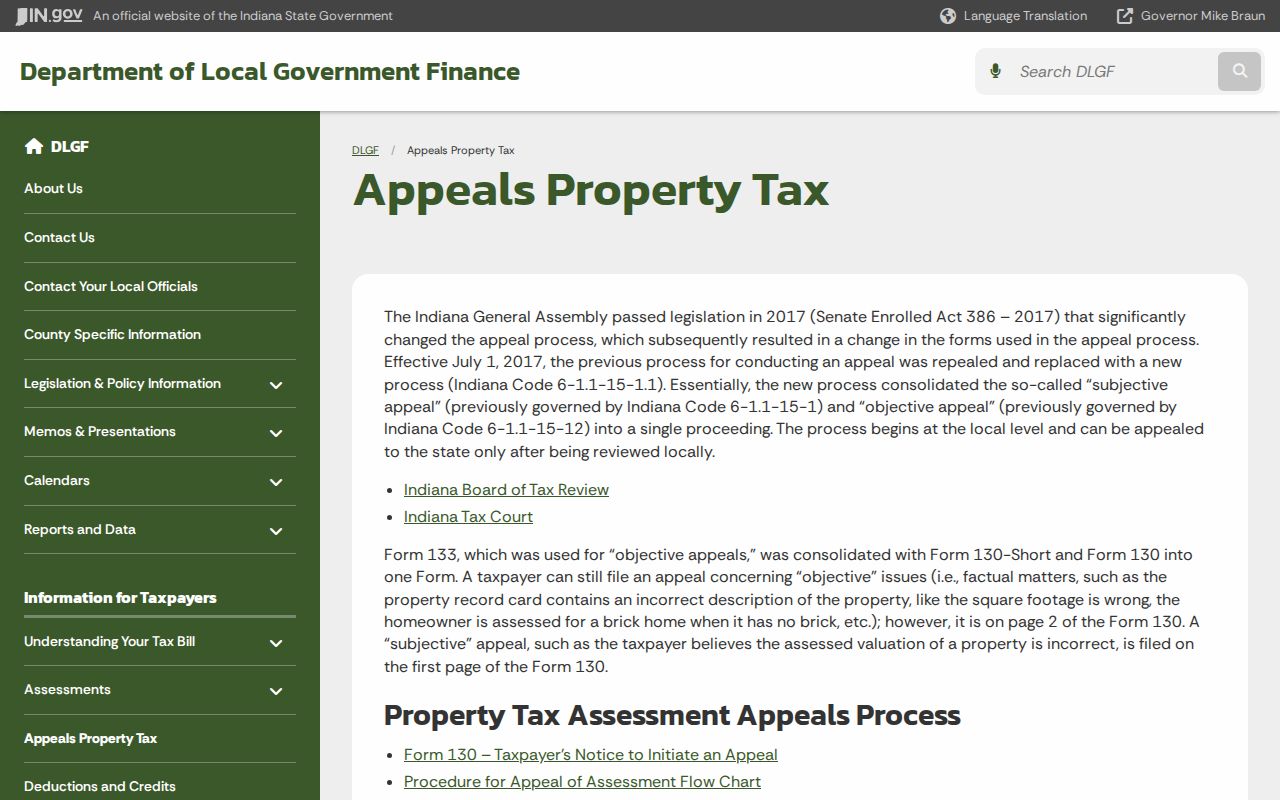
The DLGF page is a process aid. Pike owners should still use the current form, file one petition per parcel, and keep proof of delivery with their property evidence.
Pike Values Reflect Local Change
Pike County's assessment story has been anything but flat. The DLGF narrative for Pike traces falling power-station and mine influence, new solar development, and varied township groupings. Change has not arrived evenly. The 2025 land order separates Petersburg commercial neighborhoods from Winslow Original Town and Woodford Addition, and it lists Spurgeon commercial rates of its own. That is why two nearby tracts can move in opposite directions while sitting in the same township.
Lake Helmerich complicates the picture further. The lake straddles the Pike and Dubois county line. Lakefront lots, off-lake parcels, association dues, and wildly uneven sale prices all demand close attention to which county holds the deed and how the parcel is classed. No county-wide trend settles a single property's value. The assessment record and the current land order remain the real evidence for any parcel dispute.
Used well, the land order works as a finding aid for Pike County property records. Petersburg carries White Oak plus its own commercial codes. Winslow splits into Woodford Addition, Original Town, commercial, and mineral neighborhoods. Spurgeon lists commercial and mineral codes too. Remember that these are assessment neighborhoods, not zoning districts. A code simply points to the right rate schedule, while the property card and the Assessor show how that rate touched one tract.
Appeal a Pike County Assessment
A Pike County owner who disagrees with an assessed value starts with Form 130 and the county appeal process. DLGF guidance sets a June 15 filing deadline. The petition must name the objective issue with the assessment. Strong evidence makes the claim concrete: comparable sales, a recent appraisal, corrected property characteristics, photographs, or records exposing a classification error. File one petition for each parcel number. No blanket filings.
The county review ends with Form 115 findings. Still unhappy? The next step runs through the Indiana Board under Form 131 and its current instructions. Appealing never pauses the tax bill, so keep payment obligations current. Confirm both deadlines with the responsible offices to protect your standing in the property records.
Appeal window. Indiana guidance gives June 15 as the assessment-appeal deadline. Confirm the active cycle and current Form 130 before filing.
Start the paper trail with the Pike County Form 130 page. The page supplies the local filing document. Keep the parcel number, assessment notice, evidence, and delivery record in one file. Form 115 records the county board's findings. Retain it alongside the original petition and every exhibit.
When no online deed or assessment record settles the question, visit or call the Assessor, Auditor, or Treasurer. All three sit at the Pike County courthouse in Petersburg. A written APRA request can seek an existing parcel card, notice, bill, receipt, or sale list. Frame the request around identifiable property records and specific years. Staff are not required to build a new analysis. If only part of a record is exempt, ask for a redacted or segregable copy.