
Tracing Former Owners of a Pike County Property
Land records in Pike County date to 1817, according to the Recorder, and every document is permanently microfilmed or scanned. That depth is the foundation for a former-owners search. It does not put every year online. Start from the current deed and build a dated worksheet as each name steps back.
| Source | Years It Covers | Where Held | What It Shows |
|---|---|---|---|
| Recorder land records | Current backward; online cutoff unverified | Recorder counter and phone | Recorded parties and dates |
| Microfilmed deed books | County says records begin in 1817 | Recorder and State Library inventory | Earlier grantors and grantees |
| Historic plats | Series varies | Recorder, library, and archives | Subdivision and lot history |
| Archived tax material | Exact run must be requested | Archives or library finding aids | Supplemental dated clues |
Treat the assessor result as a starting point. It fixes the opening parcel and current owner of record. Deeds carry the ownership sequence, plats explain changing lot descriptions, and probate or court files explain who had authority to transfer.
Pike County's Backward Transfer Timeline
A deed-chain table keeps names and tracts from drifting apart. Fill every cell only from the actual instrument, and leave unknowns blank rather than guessing.
| Transfer date | Grantor to grantee | Deed type | Book/page or document |
|---|---|---|---|
| Newest filing | Prior owner to current grantee | As recorded | Copy exact reference |
| Earlier filing | Earlier owner to prior grantee | As recorded | Copy exact reference |
| Older book | Continue the same tract | As recorded | Book and page |
These dates are labels only, not a real parcel.
The official Recorder page documents Pike County land-record history.
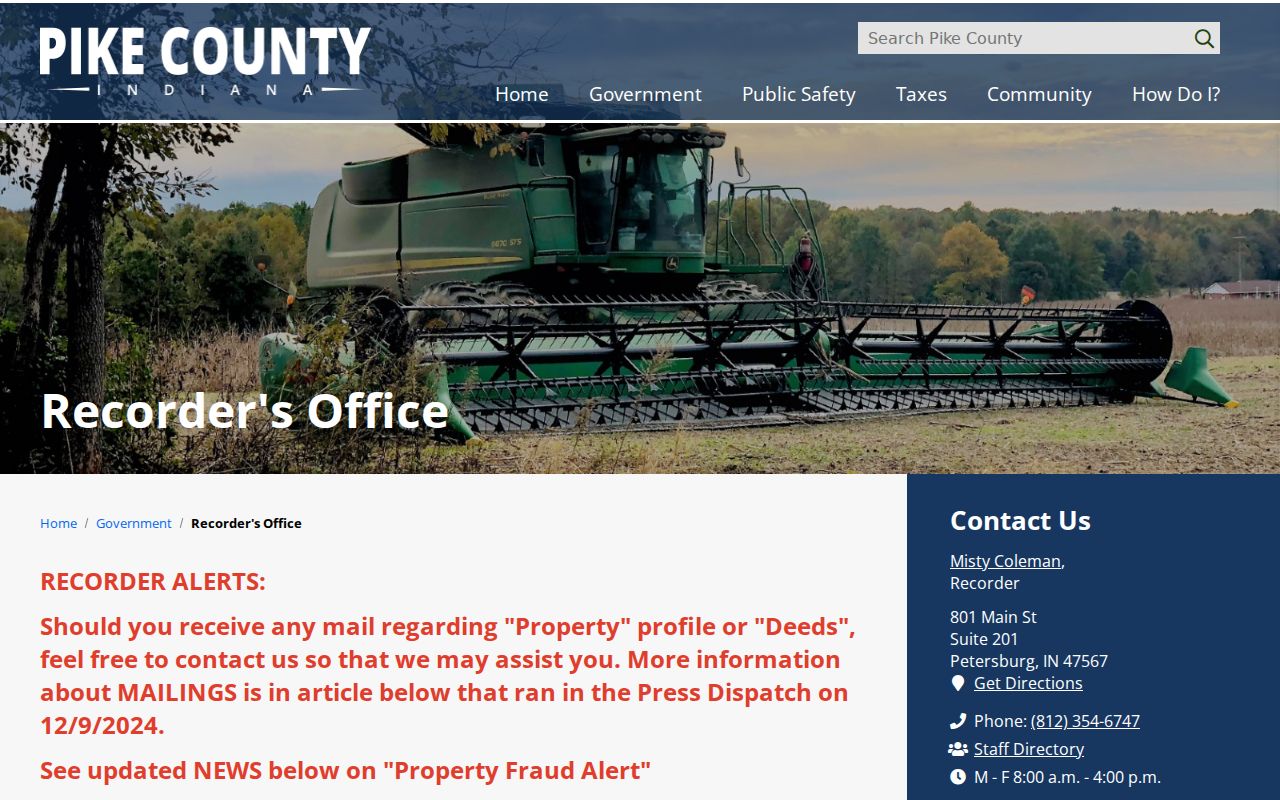
The page supports the 1817 holdings statement while leaving online depth unverified.
Pike County Deed Books Reach Back to 1817
The 1817 statement describes record history, not a verified online cutoff. Pike County publishes no official public grantor-grantee search site. No image policy or first searchable year appears. Older ownership therefore means the Recorder's counter and phone, then the State Library's preliminary Pike County microfilm inventory and the Indiana State Archives when needed.
Coverage limit. No online cutoff year was verified. Do not translate Pike County's 1817 paper holdings into a claim that all images are searchable online.
Legal Descriptions Keep Pike County Prior Owners Together
Street addresses get renumbered. A mailing city can differ from the parcel's jurisdiction, and an APN can shift after a split. The deed's legal description is the durable check. Compare subdivision, lot and block, acreage, adjoining calls, and references to earlier instruments at every backward step.
Named additions in county material, including Dempsey, Hickory Hills, Lake, and Woodland variants, show why spelling matters. Try alternate subdivision spellings. Pick the tract by description, not name.
Estates Can Interrupt a Pike County Owner Chain
A decedent's name can lead to a personal representative, trustee, heir, or court-authorized sale. Search Pike County court information through MyCase for the estate or the party. Obtain the relevant order from the Clerk if it explains authority. The executor or representative deed records the land event.
Genealogy sources help separate same-name people. The Indiana State Library Pike guide covers WPA marriage, birth, and death indexes, wills, commissioners' records, maps, histories, and newspapers. Those clues build relationships. The deed still governs the transfer.
Plats Explain Pike County Previous-Owner Breaks
A chain can appear to stop when a tract was replatted, divided, combined, or described under a different addition. Compare the recorded plat against the deed description and later parcel evidence. Similar addresses and consecutive APNs prove nothing.
The State Library lists Pike County maps, atlases, and plat books, including material for Petersburg, Otwell, and Winslow. Historic maps can place an old description. They cannot replace the recorded deed or a survey.
Tax Sales Are Pike County Chain Events
County tax-sale material lists parcel ID, owner, legal description, amount, sale ID, and status clues. It also warns that a street address or common description is not warranted, and that the complete legal description in the court order or deed controls. A sale list can flag a possible event. It is not a shortcut through the chain. Check the redemption status. Then locate the deed or court authority that completed the transfer. A listed delinquency alone never proves title passed.
Walking the Pike County Deed Chain Backward
Read the newest deed for its grantee and legal description. Search that grantor as an earlier grantee. Open the acquisition instrument for the same tract and repeat. Branch for spouses, maiden names, estates, trustees, and entity spelling. Record both execution and recording dates when available.
Chain terms
A grantor conveys; a grantee receives. A reverse index organizes the books by grantee name. A chain of title is the linked instrument history, and a quitclaim deed conveys only the grantor's interest without a warranty deed's covenants.
- Find the current grantee's purchase deed.
- Read the prior grantor from that deed.
- Search that grantor as an earlier grantee.
- Continue through deed books and microfilm.
- Grantor / grantee
- Conveying and receiving parties.
- Chain of title
- The linked sequence of instruments for one tract.
- Legal description
- The land description that survives address changes.
How Far Back Pike County Ownership Records Go
Pike County reports land records beginning in 1817. When a prior-owners trail passes beyond searchable material, call the Recorder at 812-354-6747 with the latest names, date range, legal description, and book or page. Ask which index volume and microfilm reel continues the search. Public inspection and copies are available. Exact fees must be confirmed.
The Indiana State Archives and State Library collections are secondary routes for historic county material. Their finding aids may locate a series, reel, or old map. A gap stays documented until a record closes it.
Lawful use. [1-2 sentences - former-owner research in Pike County is for house history, title research, and property diligence; using it to track or harass any living person is a crime under Indiana law.]
A Pike County Former-Owner Research Log
A short log belongs in every former-owner search. Note each spelling variant, party role, date range, legal description, and source reference. That habit keeps failed variants from being repeated and marks any unresolved gap plainly.
For older Pike County deed records, request the index volume before any deed copy. An index entry shows the book and page for the next link in the chain. When the State Library inventory lists a reel, cite it in any archive inquiry. Indiana preservation microfilm programs date to 1937. That year does not establish when a given Pike County volume was filmed.
A useful worksheet distinguishes warranty, quitclaim, trustee, representative, sheriff, tax, and correction deeds. The label describes the form, not every legal effect. Mortgages, releases, easements, restrictions, and street vacations often sit beside transfers. That is why a plain list of names misses part of the history.
The Recorder counter is the best place to resolve an unreadable index entry. It also helps with a missing book reference or a deed that cites an earlier instrument. Call before visiting to ask about public access, retrieval time, and current copy charges. Give staff a narrow name range and legal description. Do not ask them to build a title history.
End the former owners chain only where the evidence ends. A missing hit may simply mean another spelling. It could also point to an older volume, probate, or a changed legal description. It does not prove that no transfer occurred. Keep the open question intact for the next request.
A complete former owners file cites each deed in sequence and labels every unproven transition. That restraint beats a smooth but unsupported history.
Note: Preserve the final citation with the tract description and the date the search was made.